I Hired Out My System 2
Kahneman split thinking in two. The standard worry about AI is that we'll stop using System 1. That's not what's happening. Not to me.
Kahneman split thinking in two. System 1 is fast and automatic. System 2 is slow and deliberate. The standard worry about AI is that we’ll stop using System 1 — that we’ll stop noticing things, stop reacting, stop being present.
That’s not what’s happening. Not to me.
I outsourced System 2. The procedural part of it.
What that means
I run roughly twenty-five active projects across FoxxeLabs. Software, hardware, a dissertation, a fiction backlist, a marketing pipeline, a digital legacy substrate. None of it is possible without sustained deliberate thought.
But deliberate thought is two jobs, not one.
The first is judgment. Strategy. Taste. Knowing what the right thing is, and whether the thing in front of me is it. That part I keep.
The second is procedure. Writing the code that implements the strategy. Drafting the chapter that contains the argument. Synthesising forty papers into a literature review. Producing the artifact the judgment has already approved.
The procedure used to consume most of my System 2 budget. Now it doesn’t.
The substitution
Claude doesn’t replace my fast thinking. My intuitions about people, prose, and engineering are still mine, and they’re sharper at sixty-nine than they were at thirty.
What Claude replaces is the part of me that used to spend three hours producing a Product Requirements Document. The PRD is now eight minutes. The judgment that decides whether the PRD is right — what it should contain, what’s missing, what’s wrong — that’s still three hours.
But now those three hours go to the PRD I should have written, not the PRD I committed to writing.
The trade isn’t faster output. It’s better-targeted deliberation.
I tested this on myself
I’m a cyberpsychology student. I don’t get to make confident claims about my own cognition without checking them.
So I sampled my recent Claude history. Two axes: my mode (fast vs deliberate), Claude’s role (thinking vs executing). Twenty-five chunks. Noisy, owned upfront.
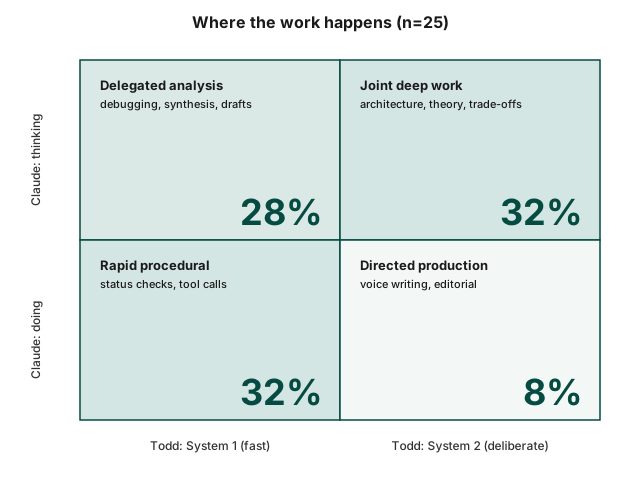
My hypothesis was that deliberate effort would split between architectural decisions and editorial production — the latter being voice writing, copy craft, the things only I can do because Foxxe Frey’s voice is mine.
The data said otherwise. Architecture was bigger than expected. Editorial was much smaller. When I go deliberate, I go strategic. Voice work I do fast — alone, in my head, occasionally throwing a paragraph at Claude to react to.
The implication is uncomfortable in the right direction. What I assumed I was carefully co-producing with the AI, I’m mostly producing alone. What I assumed I was delegating, I’m mostly co-producing.
What this is not
Not a productivity miracle.
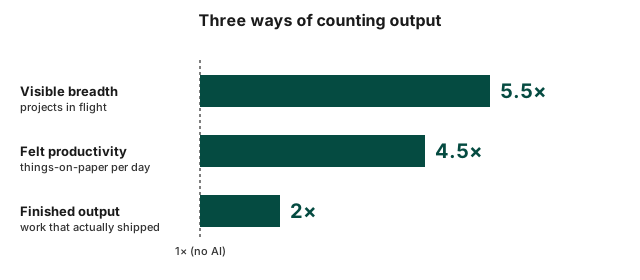
My finished output is up roughly twofold. My in-flight portfolio is up fivefold. The gap is the unfinished work on my desk — the cost of attention spread thin across more projects than any human can ship.
Not transferable advice. A different person with a different stack would draw a different matrix. Mine is shaped by fifty years of building software and sixty-nine of being me.
And not a defence of AI. It’s a description of one particular human-AI working relationship, audited honestly, including the parts that didn’t turn out the way I expected.
The aphorism
I didn’t outsource thinking. I outsourced the part of thinking that wasn’t really thinking.
What’s left is the part that was always the work.
Todd McCaffrey is a New York Times bestselling author, founder of FoxxeLabs Limited, and an MSc candidate in Cyberpsychology at ATU Letterkenny. The empirical sample for this piece was drawn from Mnemos, FoxxeLabs’ personal memory system. Visualisations were drafted in collaboration with Claude (Anthropic).